
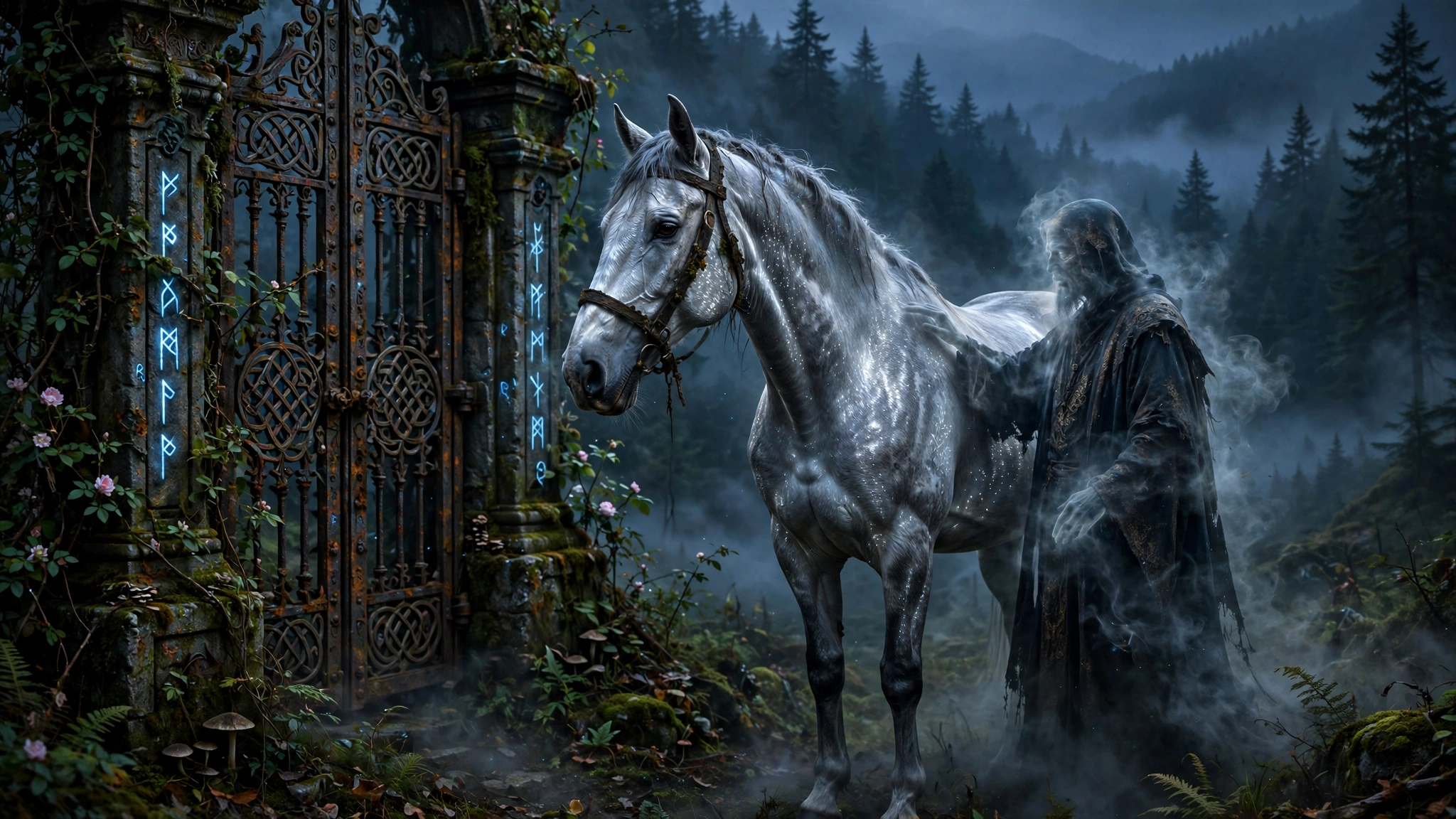
The Old Horse Who Waited at the Gate for Ten Years
For a decade, Barnaby the dapple-grey horse stood motionless at the broken iron gate, waiting for a master who vanished into the winter mist, until the day the lock began to sing.
Table of Contents
Chapter 1: The Dapple-Grey Statue and Barnaby
In the valley of Oakhaven, seasons did not merely pass; they decayed into memory like autumn leaves dissolving into black loam. Rain fell with a heavy, rhythmic cadence against the moss-covered shingles of the old Miller estate, a place abandoned to nettles and ivy for a decade.
Yet amidst the wilderness of overgrown fern and shattered limestone, one element remained immutably fixed: Barnaby. Barnaby was a large dapple-grey horse whose hide had faded to the color of sea fog, his bones jutting beneath his coat like smoothed slate ledges. For ten years, eight months, and twelve days, Barnaby had not left the rusty iron gate at the edge of the forgotten orchard. Rain ran down his long nose; snow piled upon his thick, untrimmed mane; sun dried the valley dirt onto his flanks. He stood facing north, toward the winding road that climbed into the jagged, cloud-shrouded peaks of the Spine.
The villagers had long stopped trying to lead him away. In the early years, Marcus, the village blacksmith, had brought heavy rope and ears of sweet yellow corn, attempting to pull the old horse into a warm stall. But Barnaby had anchored himself into the earth as though his hooves were oak roots reaching into the heart of the world. Ropes snapped; leather halters burst at the seams; yet the stallion’s eyes, clouded with milky cataracts that seemed to reflect faint blue starlight, remained unblinking, turned steadfastly to the north horizon.
By the fifth year, the people of Oakhaven ceased viewing him as an animal and began treating him as a landmark, a silent monument to an unspoken grief. Children left apples on the flat mossy stones beside the gate post, and old women murmured prayers for his release as they carried their water buckets past the estate.
Yet those who walked near the gate at dusk spoke of strange things. They claimed that when the evening wind whipped down from the mountains, the ground beneath Barnaby’s hooves did not rustle with dry leaves, but hummed like a plucked wire. They whispered that the shade cast by the stallion at sunset was not the shape of an old draft horse, but long, towering shadows of something ancient and antlered.
Julian, the blacksmith’s young apprentice who had grown up watching the grey horse from afar, sat upon a wooden fence post three hundred yards away, carving a cedar whistle while watching the twilight settle. Julian remembered the night Master Thomas, the old scholar who had inhabited the decaying estate, had walked up the northern mountain pass carrying only a brass lantern and a black leather journal. Thomas had told no one where he was going, leaving Barnaby tied loosely to the gate latch with a silk ribbon. The ribbon had rotted in the first spring rain, but Barnaby had never stepped back.

Chapter 2: Whispers in the Iron Lattice and Barnaby
The autumn wind blew harsh and thin through the valley, carrying the scent of pine needle smoke and damp earth. Julian approached the gate, his heavy boots sinking into the wet mud. He carried a bucket of crushed barley soaked in warm water and molasses, a small gesture he had repeated every Tuesday since his master had passed away three winters ago. Barnaby did not turn his head as the young man drew near, but his ears flattened slightly, a subtle acknowledgement of Julian’s presence that few others were ever granted.
“Still waiting, old fellow?” Julian whispered, setting the bucket near the horse’s scarred hooves. The animal blew a cloud of pale steam from his nostrils, the hot air smelling faintly of dry clover and silver ash.
Julian leaned against the cold iron of the gate, looking out toward the mountain road. The iron lattice was completely encased in wild brier rose vines, their sharp thorns black as iron pins. As Julian’s hand brushed against the latch, a strange sensation rushed through his fingers, a high-frequency vibration, like the lingering echo of a brass bell struck underground. He pulled his hand back, startled.
Looking closely at the rusted iron, he noticed intricate runes etched into the metal, glowing with a faint, phosphor-blue light beneath the layers of rust and grime. These were not the markings of local blacksmiths; they were the seals of the Deep Weaver, ancient symbols meant to hold open the doors between realms.
Suddenly, Barnaby lifted his head. For the first time in ten years, the draft horse moved his heavy hooves, shifting his weight with a crunch of gravel that seemed to echo through the valley like thunder. His ears pricked forward, locked onto the dark tree line at the base of the mountains.
A sound echoed down the valley, not the wind, nor the cry of a night hawk, but the sharp, rhythmic clinking of iron chains and the light tread of footsteps upon gravel. Julian felt the hair on the back of his neck stand on end as the temperature plunged, turning his breath to mist. Something was approaching from the high mist, something that had taken ten long years to walk down from the mountain peak.

Chapter 3: The Scholar’s Shadow and Barnaby
Out of the thick mountain fog emerged a figure, tall and stooped, wrapped in a mantle of dark wool that trailed upon the wet earth without taking a single speck of dirt. The figure carried no lantern now, yet a soft, amber light spilled from its chest, illuminating the hollow cheeks and silver beard of Master Thomas. But this was not a man of flesh and blood. Thomas’s body was translucent, revealing the dark trunks of pine trees behind him, his skin gleaming like polished river quartz under the moonlight.
Beside him walked a great silver stag whose antlers were hung with small, brass oil lamps that flickered with cold blue flame.
Julian pressed his back against the stone pillar of the gate, unable to speak, his chest heaving with cold terror and wonder. Barnaby let out a low, musical whinny, a sound so full of deep affection and relief that it tore through the quiet night like a ballad. Barnaby lowered his heavy head, pressing his forehead against the spectral hand that Thomas reached out through the cold air. Where the ghost’s fingers touched the grey horse’s skin, light spread like water, turning Barnaby’s worn coat into brilliant, shimmering silver. The scars on his legs vanished; the cataracts over his eyes melted away into clear, starry depth.
“You stayed, my faithful friend,” Thomas’s voice echoed, not through the air, but directly inside Julian’s mind, sounding like dry leaves rushing across a stone floor. “Ten years in the mortal world is but ten night-watches in the Court of the Winter King. I was held by the oaths I swore to the mountain spirits, bound to weave the thread of the valley’s winter. But the thread is finished now, and the gate must be unlocked.” Thomas turned his hollow, light-filled gaze toward Julian. “Young apprentice of the hammer,” the spirit said, “only an innocent heart who has fed the guardian may turn the key. Will you draw the latch?”
Chapter 4: The Unlocking of the Gate and Barnaby
Julian looked from the ghostly scholar to Barnaby, whose form was no longer that of an aged, dying workhorse, but a majestic spirit of the forest, radiating warmth and cosmic power. Julian realized that Barnaby had not been abandoned; he had been the anchor, holding the thin boundary between the realm of living mortals and the eternal wildness of the deep magic. Had Barnaby left the gate, the veil would have torn, letting the freezing, endless winter of the mountain spirits swallow Oakhaven whole.
The horse’s ten years of patience were a barrier of love, holding back catastrophe with every quiet breath.
Step by step, Julian approached the glowing iron latch. His hand trembled as he reached out, touching the cold metal that now burned with gentle, golden heat. The ancient runes burned brightly under his palm, recognizing the kindness he had shown Barnaby through years of solitary devotion. With a deep breath, Julian lifted the iron bar. The sound of the lock opening was like the splitting of a mountain peak, a clear chime that rang out across the entire valley, waking the birds in their nests and calling the villagers from their sleep.
As the iron gate swung wide for the first time in a decade, a warm, summer breeze blew outward from the estate, melting the frost on the grass and filling the night air with the scent of blooming apple blossoms and sweet wild honey. The dark, decayed orchard behind the gate transformed in an instant into a glowing meadow under a twilight sky that knew no winter. Thomas smiled, stepping backward through the threshold into the light, his stag bowing its antlered head to Julian.
Chapter 5: Beyond the Threshold and Barnaby
The atmosphere of Oakhaven had always been one of heavy, velvet stillness, a place where time did not so much flow as it did pool, stagnating in the hollows of the valley. But tonight, the air tasted of ozone and ancient, forgotten sunlight.
Barnaby turned his head toward Julian one last time. The great grey stallion, whose coat had been the color of a winter storm for a decade, now caught the luminescence of the unfolding veil. He leaned down, his neck arching with a grace that spoke of leagues conquered and patience perfected. He pressed his velvet muzzle against the young apprentice’s cheek.
It was a sensation of impossible warmth, a dry, soft heat that smelled of sweet hay, clover, and the metallic tang of the forge. In that touch, there was no sound, yet Julian heard it clearly: a silent benediction, a transference of resolve. It was a final blessing of strength and luck bestowed upon the blacksmith’s hands, hands that had known only cold iron and solitude until this very moment.
Julian shivered, though the air around them was balmy. He felt the phantom weight of the horse’s history, the ten years of standing, the ten years of watching the horizon for a rider who had been claimed by the earth long ago. And then, the gravity shifted.
With a movement that defied the physics of muscle and bone, Barnaby sprang. It was a leap that seemed to tear the very fabric of the twilight, a majestic vault across the threshold into the golden meadow that had, until this heartbeat, remained invisible to mortal eyes. As his hooves struck the radiant soil of the spirit world, they did not thud; they chimed like bells struck beneath water.
Where his feet landed, the earth erupted in sudden, miraculous life. Footprints of wild lilies and golden wheat blossomed instantly under the starlight, their petals unfurling with the frantic, beautiful speed of a sped-up life cycle.
Julian stumbled forward, his boots catching on the uneven threshold, his eyes wide. Beside the shimmering form of the stallion stood Master Thomas. The old man, once a ghost of a memory, looked vibrant now, his form etched in the same golden light that bathed the meadow. Beside them waited the stag, a creature of antler and shadow, its presence a tether to the wild places of the world that had existed long before the first stone of Oakhaven was laid.
Together, the scholar, the stag, and the silver horse began to walk. They moved toward the distant, glowing hills of the eternal spring, their figures silhouetted against a horizon that breathed with the pulse of a thousand dawns. Julian watched, paralyzed by the sheer, agonizing beauty of the departure. Their shadows, cast by no visible sun, began to bleed together, intertwining into a single, blinding pillar of light that stretched, thinned, and finally vanished into the far-off curvature of the sky.
The iron gate, which had groaned under the weight of rusted hinges for a decade, closed softly. There was no harsh metallic shriek, no finality of a latch slamming home. Instead, it was the gentle, melodic whisper of wind passing through aspen leaves. Julian reached out, his fingers brushing the iron bars. Where once the metal had been scarred by biting frosts and the creeping rot of neglect, it now felt smooth, almost organic.
Slowly, as if exhaling a long-held breath, the ancient runes carved into the metal, the warding symbols Julian had spent months trying to decipher, began to fade. The glowing blue light dimmed, the etchings smoothed over by the passage of unseen currents, returning the iron to its base, honest state of weathered grey rust.
Then, the change truly took hold. The oppressive, suffocating mist that had clung to Oakhaven for ten long years, the grey shroud that had turned the valley into a sepulcher, began to dissolve. It didn’t lift; it disintegrated, turning into harmless, glittering motes of dust that caught the first, true rays of a crystal-clear morning sun. The sky, once a bruised, eternal twilight, fractured into a brilliant, wide-open expanse of azure.
From the village below, the sound of movement finally reached Julian’s ears. Distant shouts, the rhythmic thud of boots on cobblestone, and the frantic barking of dogs announced the approach of the villagers. They had been watching the horizon for a sign, and now, seeing the mist retract, they were coming with the clumsy urgency of men who had been afraid for too long.
They arrived in a frantic, stumbling knot, the Miller family, the blacksmith, and the village elders, clutching lanterns and pitchforks as if they expected to fight the ghosts they had lived with for a decade. They stopped abruptly at the edge of the estate.
They found only Julian.
He stood alone at the open gate, his silhouette framed by the burgeoning sunlight. Barnaby, the legendary guardian of the gate, was gone. There was no sign of struggle, no tracks leading into the woods, only a perfect, circular patch of deep, vibrant green grass where he had stood for ten thousand hours. The clover there was tall, white, and impossibly sweet-scented, as if the earth itself had been fertilized by a decade of pure, unadulterated devotion.
“Julian?” the blacksmith called out, his voice cracking with a mixture of terror and hope. He pushed forward, his eyes searching the empty field, his chest heaving. “The horse? Where is the beast?”
Julian did not answer immediately. He looked down at his own hand. Wrapped around his fingers, catching the new, warm light of the sun, was a single, long hair from Barnaby’s mane. It was silver, brighter than moonlight, and it hummed with a faint, residual static that made the hair on Julian’s arms stand up.
He closed his fist, tucking the memory against his palm. He looked at the villagers, men and women who had grown gaunt and hollow-eyed waiting for a dawn that never came. He saw their confusion, their frantic need for an explanation that could fit into their small, terrestrial world.
“He isn’t waiting anymore,” Julian said, his voice quiet but carrying with a startling, crystalline clarity across the clearing.
“Waiting?” the elder Miller asked, stepping forward, his hands shaking. “Waiting for what, boy? The master? The return of the dead?”
Julian looked toward the hills, where the morning light seemed to dance with a residual, joyful energy. He smiled, a soft, private expression that contained the weight of all he had witnessed. He knew that Barnaby was no longer bound by the geography of a gate or the loyalty of a long-dead master. He was running free, his hooves pounding against soil that knew no winter, his lungs filling with air that never grew cold. He was galloping through fields of eternal spring, his stride long and unburdened, his heart finally reclaimed from the threshold.
“He was waiting for permission,” Julian replied, turning away from the gate to face the villagers. “And he found it. The gate is open, and Oakhaven is awake.”
The villagers looked at the empty field, then at the sky, then at the young man who seemed to have grown years older in a single night. They didn’t understand, but as the sun warmed their faces, a warmth they hadn’t felt in a decade, they lowered their pitchforks.
The valley of Oakhaven would change, of course. The stories would be told, then embellished, then forgotten, and finally etched into the very soil of the land. They would remember the silence, but more importantly, they would remember the guardian who had saved them not with a weapon, but with the quiet, terrifying, and beautiful endurance of his love. Julian turned back toward the gate one last time, whispered a final, soft “Thank you” into the breeze, and walked home, the silver hair still warm in his hand.

Further reading: Learn about grey horse coat colours, including how grey coats turn silver with age, at the Veterinary Genetics Laboratory.


