
The Lipizzaner Horse: A Legacy of Elegance and Equestrian Artistry
Table of Contents
White Stallions and Whispers of Royalty
Imagine a world where beauty is not just seen, but felt – a profound connection to a living legacy that transcends mere spectacle. If you’ve ever dismissed a horse as simply a mount or a working animal, prepare to have your perceptions challenged.
For in the majestic Lipizzaner horse, you encounter a creature meticulously sculpted by centuries of royal decree and dedicated horsemanship, embodying grace, power, and a history so rich it feels like a whispered secret waiting to be unveiled.
From ancient battlefields to the dazzling precision of the arena, horses have perpetually captivated humanity, symbolizing strength, freedom, and an enduring partnership.
Yet, among these magnificent creatures, the Lipizzaner stands as a unique monument – not merely an animal, but a living piece of art, a symbol of grace, power, and centuries of tradition that continues to enthral audiences worldwide.
What truly makes the Lipizzaner horse unique is its unparalleled status as a living monument to classical horsemanship and European heritage, a testament to an unwavering commitment to beauty, discipline, and a lineage meticulously preserved.
This article invites you on an in-depth exploration of their aristocratic origins, the distinguishing characteristics that define their elegance, and the unparalleled training that elevates them to the pinnacle of equine artistry.
The Royal Bloodline: Origins and Development of the Lipizzaner Horse
The story of the Lipizzaner horse is inextricably woven into the tapestry of European royalty, a testament to a dynasty’s vision and dedication. It begins not with chance, but with a deliberate, strategic ambition to create the ideal equine partner for an empire.
The Habsburg Dynasty’s Vision: How an Empire Forged a Breed
The 16th century in Europe was a time of burgeoning empires and constant change, where the power of a noble house was often measured by the strength of its cavalry and the magnificence of its ceremonial mounts. For the mighty Habsburg Dynasty, who ruled over vast swaths of Central Europe, the strategic importance of robust warhorses capable of carrying heavily armored knights, and magnificent ceremonial mounts befitting their imperial stature, could not be overstated. They needed horses that were not only powerful and agile but also possessed the beauty and presence to command attention in parades and stately functions.
It was Emperor Maximilian II, a passionate horseman and visionary ruler, who first initiated the systematic breeding program that would eventually lead to the Lipizzaner. His fascination with the elegant and spirited horses of Spain – particularly the famed Andalusian – prompted him to import Spanish horses to his court in Vienna. Later, his nephew, Archduke Charles II, the son of Ferdinand I, would solidify this vision. Recognizing the potential to create a distinctive, superior breed, Archduke Charles II established the imperial stud farm, laying the true foundation for what we now know as the Lipizzaner. This commitment to developing an equine paragon would define the breed for centuries to come, but where exactly did this extraordinary journey begin?
Lipica and the Karst Region: The Cradle of the Breed
The specific location chosen for this ambitious breeding endeavor was as critical as the vision itself. In 1580, Archduke Charles II of Inner Austria founded the Lipica Stud Farm in what is now modern-day Slovenia. The name “Lipica” itself comes from the Slovenian word “lipa,” meaning linden tree, which still graces the landscape. This dedicated breeding ground was not merely a farm; it was a sanctuary chosen for its unique environmental factors.
The Karst region, with its distinctive limestone terrain and fluctuating climate of warm summers and cold winters, played a crucial role in shaping the horses’ resilience and physical hardiness. The rocky ground, combined with the rigorous natural environment, encouraged the development of strong hooves, robust bones, and exceptional stamina in the young stock. This foundation in a challenging natural setting ensured that the breed was not only beautiful but also inherently tough and enduring. However, the distinct environment was only one piece of the puzzle; the true magic lay in the careful selection of the founding sires and their diverse origins.
Founding Fathers: The Six Classical Stallion Lines
The lineage of the Lipizzaner can be meticulously traced back to six foundational stallion lines, each contributing unique genetic traits that, through generations of careful selective breeding, produced the harmonious balance of power, intelligence, and inherent beauty characteristic of the breed today.
These six classical stallion lines are:
* Pluto (born 1765): A grey Danish Frederiksborg stallion, representing a robust, classical heavy warmblood type, bringing strength and presence.
* Conversano (born 1767): A black Neapolitan stallion, contributing the elegant frame, agility, and a naturally elevated way of going that is prized in classical dressage.
* Favory (born 1779): A dun Kladruber stallion, noted for his impressive size, strength, and noble head. Kladrubers themselves have Spanish and Neapolitan roots.
* Maestoso (born 1773): A grey Kladruber stallion, another descendant of Spanish and Neapolitan ancestry, known for his refined bone and good temperament.
* Neapolitano (born 1790): A brown Neapolitan stallion, further enhancing the breed’s natural elegance, high knee action, and intelligence.
* Siglavy (born 1810): A grey Arabian stallion, introduced later, injecting incredible refinement, stamina, endurance, and the characteristic dished profile and expressive eyes.
The influence of Spanish, Arabian, and Neapolitan bloodlines in their genetic makeup is paramount. The Spanish horses provided the original framework of power and agility, the Neapolitans contributed elegance and natural collection, and the Arabians introduced unparalleled endurance, refinement, and intelligence. This meticulous selective breeding, focused on combining strength, intelligence, and inherent beauty, was not left to chance. It was a centuries-long scientific endeavor to create an equestrian masterpiece. But what specific traits emerged from this royal design, setting the Lipizzaner apart from all others?
Defining Elegance: Physical Traits and Temperament of the Lipizzaner
The Lipizzaner horse is instantly recognizable, not just by its iconic color but by a combination of physical attributes and a noble disposition that speak of centuries of careful refinement. They embody an ideal of equine elegance that is both aesthetically captivating and functionally superb.
Distinguishing Physical Characteristics
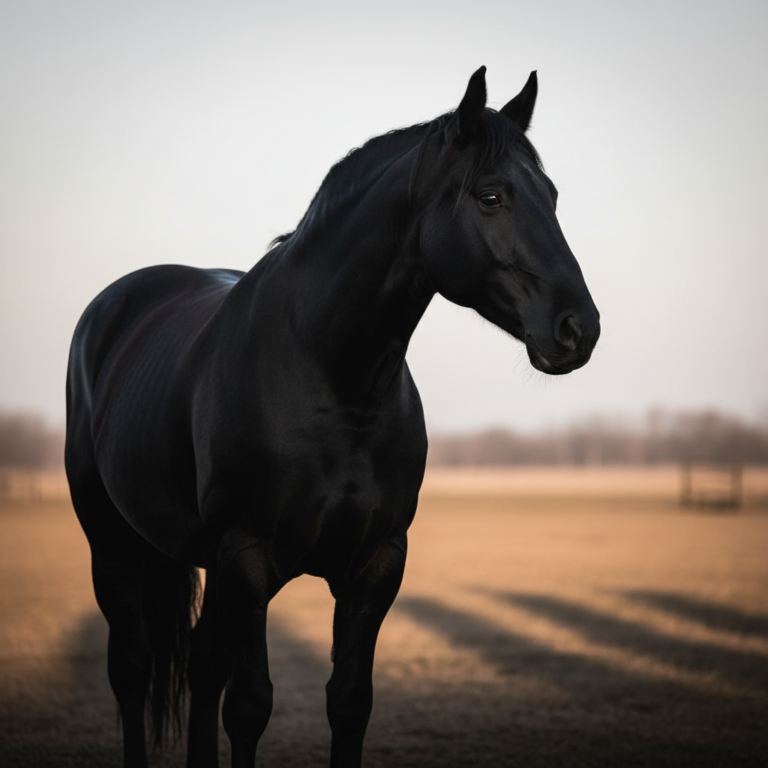
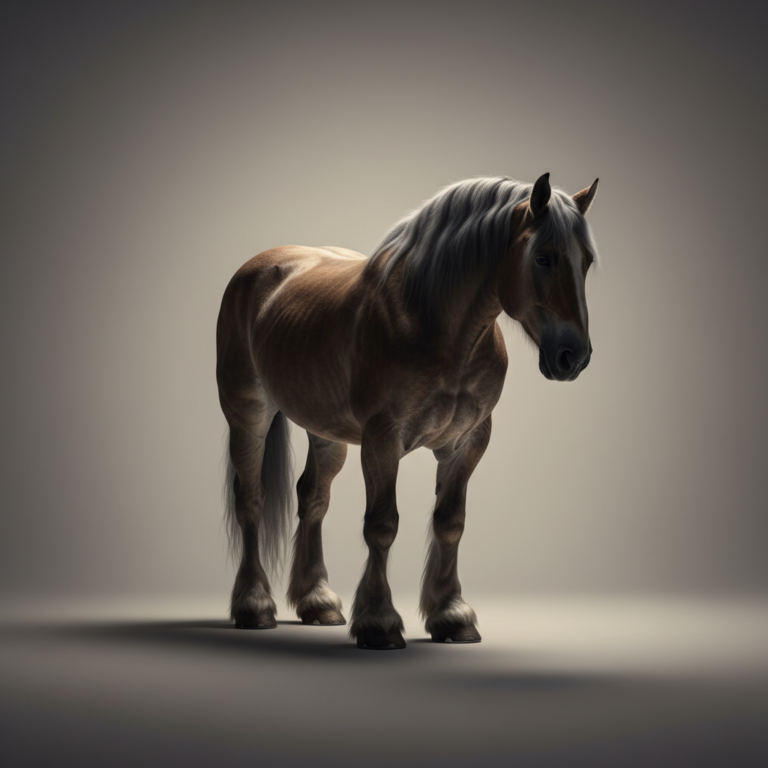
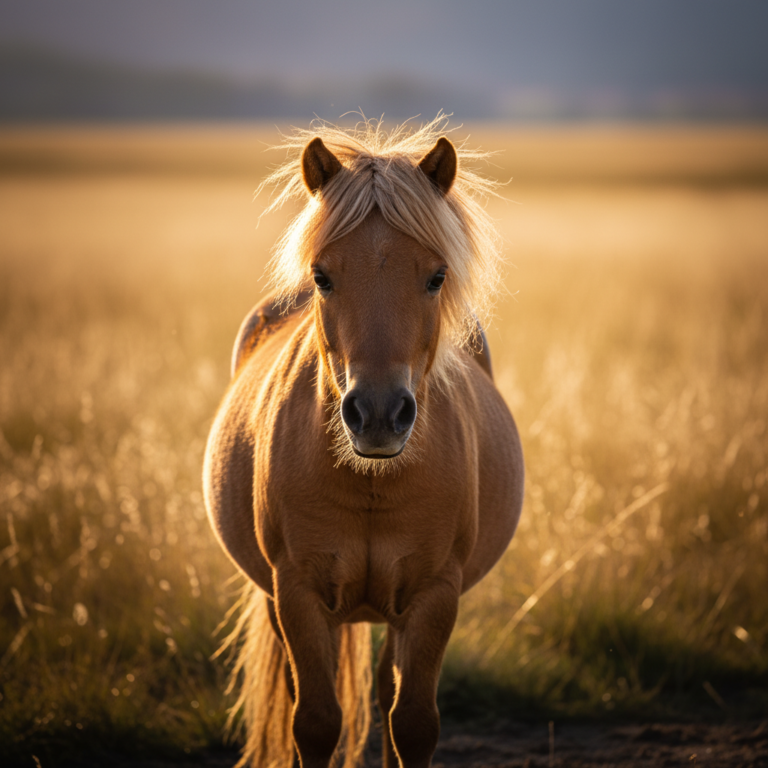
The most iconic and often misunderstood characteristic of the Lipizzaner is its coat color. While they are famously known as the “white stallions” of Vienna, Lipizzaners are actually born dark, typically a dark grey, brown, or even black. Over a period of 6 to 10 years, sometimes longer, their coat gradually lightens until it becomes the gleaming white or light grey that is so revered. This unique chromatic transformation adds to their mystique and symbolizes their journey from raw potential to refined majesty.
Beyond color, their physical structure is a marvel of balanced power and grace. They possess a muscular, compact build, with strong hindquarters that are the engine for their powerful movements, and a broad, deep chest indicative of great stamina. The neck is typically long, well-muscled, and elegantly arched, setting the head proudly. Their head itself is often described as expressive, with large, intelligent eyes that convey a profound depth of spirit. The profile can range from straight to slightly convex, or even mildly dished, especially with the Arabian influence. Overall, their proportions are harmonious, contributing to an impression of noble grandeur.
Perhaps most striking is their naturally balanced movement and an impressive, elevated gait. They move with an inherent grace, often displaying a natural high knee action and a rhythmic, cadenced step that makes them appear to float above the ground. This innate athleticism and beautiful way of moving are precisely what make them so suited for the demands of classical dressage. However, beauty is more than skin deep; the Lipizzaner’s true essence is equally defined by its character.
The Lipizzaner’s Noble Disposition
A horse of the Lipizzaner’s caliber requires not only physical prowess but also an exceptional mind and spirit. They are celebrated for their outstanding intelligence and quick learning ability, making them highly trainable. This is coupled with an earnest willingness to please their rider, fostering a deep and responsive partnership crucial for the intricate demands of classical horsemanship.
Remarkable strength, stamina, and resilience are also hallmarks of the breed. These traits, honed over generations in the challenging Karst landscape and through centuries of selective breeding for performance, enable them to endure the rigorous, multi-year training required to master the highest levels of dressage. Despite their powerful physique and spirited nature, Lipizzaners generally exhibit a gentle, courageous, and loyal disposition. This temperament allows them to form strong, trusting bonds with their riders, a relationship that goes far beyond mere command and obedience.
Their innate suitability and aptitude for the complexities of classical dressage are perhaps their most defining temperamental attributes. They possess the natural balance, mental focus, and physical strength to learn and perform the most demanding movements, including the famous “Airs Above the Ground.” This unique combination of physical elegance and noble spirit has made the Lipizzaner horse the quintessential performer for one of the world’s most revered equestrian institutions. But what exactly does this pinnacle of horsemanship entail, and how do these white stallions become living works of art?
The Pinnacle of Horsemanship: Lipizzaners and the Spanish Riding School
For centuries, the name Lipizzaner has been synonymous with one institution: the Spanish Riding School of Vienna. Here, tradition isn’t just observed; it’s meticulously practiced, elevating horsemanship to an art form that captivates and inspires.
A Living Tradition: The Wiener Hofreitschule (Spanish Riding School)
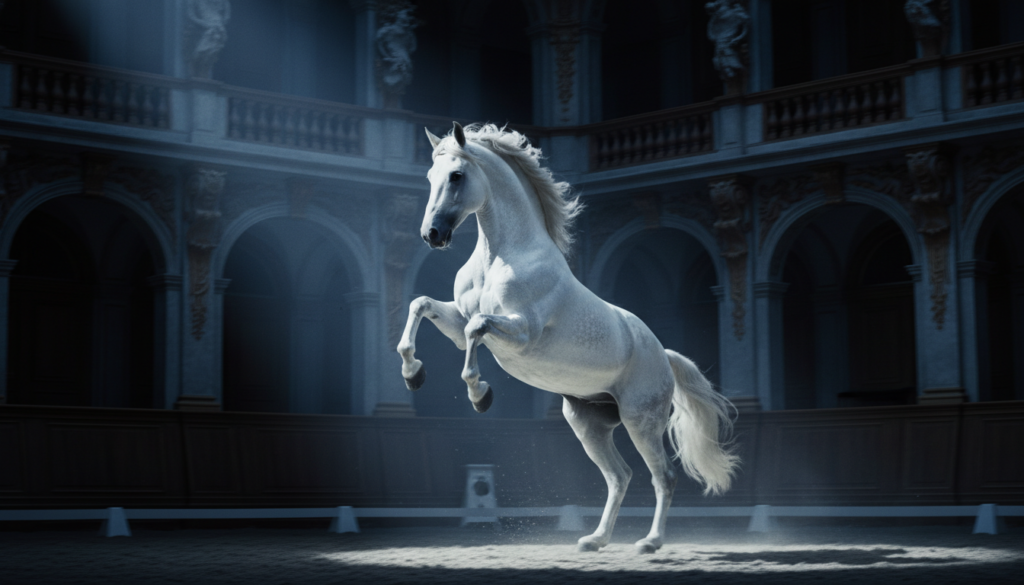
The Spanish Riding School, or Wiener Hofreitschule, is the oldest and last riding school in the world to exclusively practice and preserve classical dressage in its purest form. Its history traces back to the 16th century, formally established in 1729 with the completion of its magnificent baroque winter riding hall. Its enduring purpose remains steadfast: to preserve the art of classical horsemanship, passed down through an unbroken lineage of master riders and horses. This institution is more than a performance venue; it is a living museum, a testament to a profound cultural heritage.
The exclusive role of the Lipizzaner horse as the performer and protagonist of the school is absolute. For over 450 years, only Lipizzaners have been trained and ridden here. Their unique blend of intelligence, strength, beauty, and noble temperament makes them the ideal, indeed the only, choice for mastering the demanding curriculum of the High School of classical horsemanship. They are not merely horses performing tricks; they are partners in an elaborate, highly refined equestrian ballet. But what precisely does this ballet entail, and how do these horses achieve such extraordinary feats?
The Art of Classical Dressage: From Basic Principles to “Airs Above the Ground”
The training of a Lipizzaner at the Spanish Riding School is a lengthy, patient, and highly disciplined process that spans many years, often taking up to a decade to reach the highest levels. It begins with foundational training, focusing on developing the horse’s natural balance, strength, suppleness, and responsiveness. This “Remontenschule” phase teaches the young horse to carry a rider correctly, to move forward with rhythm and impulsion, and to become soft and obedient to the aids. Gradually, through “Campagneschule” and then “High School” (Hohe Schule), the movements become more refined and collected.
The intricate “School Quadrille” is a breathtaking display of this foundational mastery – a ballet of eight synchronized white stallions and their riders moving in perfect harmony, performing complex figures and changes with astounding precision. It is a testament to years of dedicated training, creating an illusion of effortless, flowing motion. Yet, it is the spectacular “Airs Above the Ground” that truly define the pinnacle of classical horsemanship, showcasing the Lipizzaner’s incredible athleticism and the unparalleled skill of the Reiter (rider-gentleman).
The Spectacular “Airs Above the Ground”: High-Level Masterpieces
The “Airs Above the Ground” are historic and highly stylized movements derived from the classical war maneuvers of the past, requiring immense strength, balance, and collection. These are not innate movements but are carefully taught over many years, revealing the sheer athleticism and willingness of the Lipizzaner.
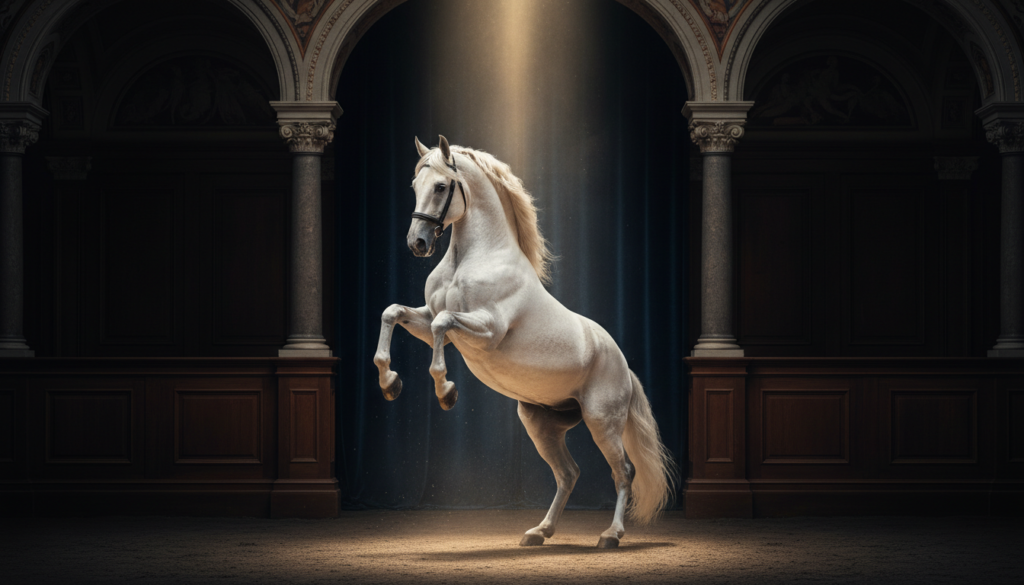
* Levade: One of the most iconic airs, the horse raises its forehand off the ground, standing on its deeply bent hind legs at a 30-45 degree angle. It’s a powerful pose, demonstrating extreme collection, balance, and strength, holding for several seconds as if frozen in time.
* Courbette: Building on the Levade, the horse performs a series of several consecutive leaps forward on its hind legs only, with the forelegs tucked gracefully beneath its chest. This movement requires extraordinary power and control, a true demonstration of vertical impulsion.
* Capriole: The most spectacular and demanding of the airs, the horse leaps into the air from a collected canter, kicking out powerfully with both hind legs in mid-air, parallel to the ground, before landing. It’s a breathtaking display of raw power and athletic precision.
* Piaffe and Passage: While not “above the ground,” these are fundamental high-level movements. Piaffe is a highly collected, elevated, and rhythmic trot in place, showcasing incredible engagement and agility. Passage is a majestic, highly elevated, and slow-motion trot, characterized by a prolonged moment of suspension, giving the impression of floating.
These magnificent displays are the result of a profound symbiosis and communication between the rider (the ‘Reiter’ or ‘rider-gentleman’) and the horse. It is a relationship built on trust, respect, and years of mutual understanding, where the rider’s subtle aids are met with the horse’s willing and artful response. This deep connection, forged in the arena, has ensured the survival of the breed and its traditions, yet the Lipizzaner horse faces modern challenges even as its relevance grows.
Beyond the Arena: Conservation and Modern Relevance of the Lipizzaner Horse
The journey of the Lipizzaner horse has not been without peril, showcasing remarkable resilience and a global commitment to its preservation. Today, these magnificent animals continue to inspire far beyond the confines of the Spanish Riding School.
Challenges and Triumphs in Conservation
The 20th century brought immense challenges to the Lipizzaner breed, most notably the near-extinction during World War II. As the war raged, the valuable breeding stock from the original Lipica farm and other studs faced grave danger. Their rescue, immortalized in Disney’s “Miracle of the White Stallions,” was orchestrated by U.S. General George S. Patton, himself an avid horseman. In a daring operation, Patton’s troops located and evacuated the horses from Czechoslovakian territory, bringing them to safety. This heroic effort saved the breed from certain destruction and allowed its lineage to continue.
Since then, ongoing international efforts have been crucial in maintaining genetic diversity and ensuring the breed’s health. Meticulous studbooks are maintained by various national Lipizzaner organizations and the Lipizzaner International Federation (LIF), carefully tracking bloodlines and breeding patterns. These efforts aim to prevent inbreeding and preserve the unique characteristics of each of the founding stallion lines. Today, a global network of Lipizzaner breeders and enthusiasts, spanning continents from Europe to North America and Australia, is dedicated to the breed’s future, ensuring its survival and continued prosperity for generations to come. But what roles do these celebrated horses play in the contemporary world?
Lipizzaners Today: More Than Just Performers
While their historical role in classical dressage and at the Spanish Riding School remains prominent, Lipizzaners today are involved in a much broader spectrum of equestrian activities. Their intelligence, athleticism, and cooperative nature make them highly versatile. They continue to excel in classical dressage competitions, but their presence is also growing in other equestrian sports, sometimes even in driving disciplines.
Beyond performance, their gentle and sensitive temperament makes them increasingly involved in therapeutic riding and equine-assisted activities. Their calm demeanor and rhythmic gaits can provide profound physical and emotional benefits to individuals with special needs. Furthermore, Lipizzaners serve as cultural ambassadors, captivating audiences and drawing tourists to their studs and performances worldwide, sharing their rich historical narrative and spectacular artistry. The enduring appeal and fascination with their story continue to captivate enthusiasts, cementing their place not just in equestrian history, but in global culture.
The Future of the Lipizzaner Horse
The future of the Lipizzaner horse involves a delicate balancing act: preserving centuries-old traditions while embracing modern advancements. Veterinary science and genetics continue to evolve, offering new tools for monitoring the breed’s health, optimizing breeding practices, and understanding genetic predispositions. The challenge lies in utilizing these advancements responsibly, ensuring the breed’s vitality and genetic integrity without diluting the qualities painstakingly cultivated over hundreds of years. Education and outreach are vital to inspire new generations of riders, breeders, and enthusiasts. The global Lipizzaner community remains committed to ensuring the breed’s health, vitality, and continued existence, securing its legacy for the centuries yet to come.
The Immortal Spirit of the Lipizzaner
From the strategic vision of the Habsburg Dynasty to the meticulous breeding in Lipica, and from the intense discipline of the Spanish Riding School to their global conservation efforts, the Lipizzaner horse has journeyed through centuries to become a true global icon. We have explored their aristocratic origins, tracing the influence of the six classical stallion lines that forged their powerful yet elegant physique. We’ve admired their iconic white coats, expressive eyes, and natural aptitude for advanced movements, all underpinned by an exceptional intelligence and a noble, willing spirit.
The Lipizzaner horse is a unique blend of elegance, intelligence, and unparalleled historical significance. They are not merely performers but “living art,” a testament to centuries of dedicated, passionate horsemanship where human and animal coalesce into a singular, breathtaking expression of grace and power. The discipline, the tradition, and the profound bond between horse and rider define their essence. The Lipizzaner is not merely a horse; it is a vibrant legacy, a breathtaking art form, and an enduring symbol of equine beauty and human dedication, continuing to whisper tales of royalty and mastery with every elevated stride.
FAQ
Are Lipizzaner horses from Spain or Portugal?
Neither. While their ancestors include Spanish and Arabian horses, the Lipizzaner breed was founded in 1580 at the Lipizza stud farm in modern-day Slovenia, under the Austrian Habsburg Empire.
What is special about Lipizzaner horses?
They are world-renowned for their intelligence and ability to perform “Airs Above the Ground,” which are high-level classical dressage maneuvers like the Levade and Capriole.
Are Lipizzaner horses born black?
Yes, Lipizzaner foals are typically born dark black, bay, or brown. They gradually turn white (grey) as they age, a process that usually takes between 6 to 10 years.
Can you see Lipizzaner horses in Vienna?
Yes, the Spanish Riding School of Vienna is the most famous place to see them. You can watch their morning exercise, guided tours, or grand gala performances in the imperial arena.
Why are they called “Spanish” horses if they are Austrian?
The name “Spanish Riding School” refers to the Spanish horses that were the foundation of the breed, as Spanish stock was considered the most talented for classical horsemanship at the time.
Are Lipizzaner horses always white?
The vast majority are grey (appearing white), but occasionally a bay or black Lipizzaner is born and kept at the school as a tradition to bring good luck.
Are Lipizzaners a rare breed?
Yes, they are considered a rare breed with a relatively small population worldwide. Their preservation is a matter of global cultural commitment.
Are Lipizzaner horses good for beginners?
Generally, no. They are highly intelligent and sensitive athletes bred for precision. They require an experienced hand to manage their strength and training.
📚 References
- Official breed standards and history can be explored at the Spanish Riding School of Vienna, the global home of the Lipizzaner.
- Registration and breeding guidelines are provided by the Lipizzan International Federation (LIF), ensuring the purity of the lineage.
- Pedigree tracking and North American standards are managed by the Lipizzan Association of North America (LANA).
- Detailed historical context and cultural significance of the breed is available via Encyclopaedia Britannica.